 English
 Azərbaycanca
 Deutsch
 Español
 Français
 Հայերեն
 Italiano
 ქართული
 Русский
 Türkçe
 中文
中文
Driving in Georgia: documents, road rules and what to expect
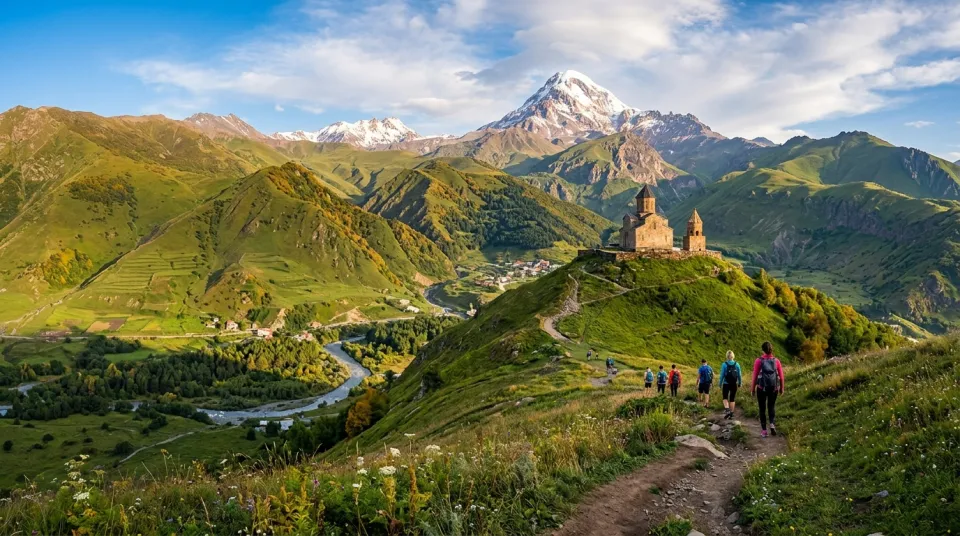
Georgia is one of the easiest countries in the Caucasus to explore by car. Distances are short, the main highway from Tbilisi to the Black Sea is fast and free of tolls, and a car takes you to monasteries, canyons and mountain villages on your own schedule.
It is also a country with its own driving habits, mountain passes that close in winter and a few rules worth knowing before you set off. This guide covers the documents you need, the rules the police enforce and what the roads are really like.
Your driving licence
A valid national driving licence lets a visitor drive in Georgia for up to one year from the day they enter the country. Georgia is a party to the 1968 Vienna Convention on Road Traffic, so there is nothing to exchange and no test to take.
Bring the physical card. A photo of your licence, or a digital licence in a phone app, is not accepted.
If your licence is not written in the Latin or Cyrillic alphabet, carry an International Driving Permit with it. The permit is a translation, not a licence of its own, and is only valid alongside the original. Many drivers bring one anyway: it makes a police check quicker, and it helps at a border if you plan to leave Georgia by car.
Each rental company sets its own minimum age and the number of years you must have held your licence, so check its conditions before you book.
Speed limits for cars
| Where | Limit |
|---|---|
| Residential zones | 20 km/h |
| Towns and villages | 60 km/h |
| Outside towns and villages | 90 km/h |
| Motorways | 110 km/h |
Some city roads carry a higher limit, such as the airport road in Tbilisi at 80 km/h. Where a sign shows a limit, the sign applies.
The rules the police enforce
The blood alcohol limit is 0.3 per mille, low enough that a single drink can take you over it. The only safe rule is not to drink before you drive.
Seat belts are compulsory in the front seats. Wear one in the back as well.
A phone may only be used hands-free. Holding one at the wheel is an offence.
Dipped headlights are required at night and in poor visibility.
Fines are registered to the car, so a fine incurred in a rental car reaches the rental company, which will pass it on to you. A penalty notice from the police can be paid at any bank.
What the roads are like
The main east–west highway, from Tbilisi past Gori and over the Rikoti Pass towards Kutaisi and the coast, is a modern road for most of its length. Its hardest stretch, the climb over the Rikoti Pass, was replaced at the end of 2025 by a four-lane motorway with 51 tunnels and 97 bridges. There are no toll roads anywhere in Georgia.
Away from the highway, roads narrow quickly. Expect potholes on smaller routes, cows and sheep that treat the road as their own, and minibuses that stop wherever a passenger waves. Overtaking can be bold, even on blind bends, so leave space and let faster drivers go.
Many rural and mountain roads are unlit. Plan long drives so that you arrive before dark.
Mountain roads and the seasons
The Georgian Military Road to Kazbegi (Stepantsminda) crosses the Jvari Pass, the highest point of the route. In winter the pass closes several times a season, sometimes for days, when snow or the risk of avalanches is high, and the police may require snow chains. Check the road status before you set off.
Tusheti is reached only over the Abano Pass, on an unpaved mountain road. It is open for roughly four months a year, from early summer until the first heavy snow in autumn, and only to four-wheel-drive cars with high ground clearance. Many rental companies do not allow their cars on this road at all, so ask before you book.
The road to Mestia in Svaneti is paved, but long and winding. From Tbilisi, allow a full day or break the journey on the way.
Practical tips
- Fuel stations are frequent on the main roads and sparse in the mountains. Fill up before you head into them.
- Carry some cash for small fuel stations and village shops, even though cards are widely accepted in cities and on the highway.
- Download offline maps before a mountain drive: mobile coverage can drop in the valleys.
- Street parking in central Tbilisi is paid in many areas. Read the signs and pay as they direct.
- Keep your passport, your licence and the rental documents in the car.
- In an emergency, call 112 for the police, an ambulance or the fire service.
Starting in Tbilisi?
Compare cars from local rental companies in Tbilisi.
Cars in Tbilisi
Traveller comments
No comments yet.